# public collections
Talks you already know, as an AI-ready repository.
You can't paste your own URL here — so explore ours instead. Every recording below is a session your agent could cite, shown next to the original video so you can verify each line against ground truth you already hold. Your own footage comes back in exactly the same shape.
curated:5 recordings, hand-picked/all CC-licensed & attributed/original video embedded on every page
## slide talk
 00:29:42thumbnail · i.ytimg.com (attributed)Exploring the CPython JIT — Diego Russo01## 00:00:00 Introduction to CPython JIT and SpeakerSpoken: Good morning everyone. I'm Diego Russo and today we're going to explore something exciting, the just-in-time compiler recently added to CPython. Now, before we start, a quick raise hand exercise. Raise your hand if you know what a JIT is. That's good. Right. Raise your hand if you knew that CPython has an integrated JIT in the runtime. That's good. Now we see the really the pro users here. Raise your hand if you ever used the CPython JIT. Oh, very few. Yes. That's expected by the way. Okay, so independently of your level of understanding and experience, I think this presentation is going to be useful in any case. So this is the official Python runtime, finally growing a JIT. And it's happening inside the interpreter we use every day. I'll walk you through how it works, what it looks like, and how we can use it. We're going to look at Python internals, including bytecodes, JIT mechanics, and even a bit of assembly and machine code. So if you're not used to that, don't worry, I'll keep things kind of on the big picture and but just you know, we're going under the hood. I've been writing Python for almost two decades and I spent the last 14 years at Arm, where I work as a principal software engineer in the runtimes team. I'm also one of the leads of the Python Guild at Arm, which is a company-wide community with over 1500 members. I've been contributing to CPython and its ecosystem for the last couple of years and focused mainly on performance and internals. In particular, I spent the last year working on the experimental JIT compiler and just a couple of months ago, in May, I became a core Python developer. Thank you.On screen: Exploring the CPython JIT by Diego Russo 2025 EUROPYTHON PRAGUE :: 14 - 20 July & REMOTE arm Exploring the CPython JIT EuroPython 2025 Diego Russo https://github.com/diegorusso • Using Python for almost 20 years • 14 years at Arm Ltd • Principal Software Engineer in the Runtimes team • Python Guild with 1500 members • Contributing to CPython and its ecosystem for 2 years • Contributing to the new experimental CPython JIT for over a year • Python Core Developer since May 2024 Vote to promote Diego Russo (diegorusso) as a CPython core developer. lukasz.langa 2 days ago I would like to propose promoting Diego Russo (diegorusso) as a CPython core developer. 43 votes 100% Yes 0% Do not promote Public 2025 Arm 2025 EUROPYTHON PRAGUE :: 14 - 20 July & REMOTEopen document + video →
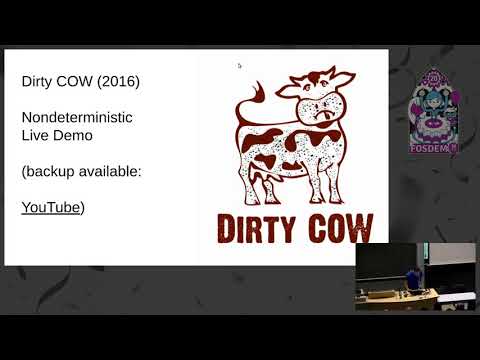 00:29:26thumbnail · i.ytimg.com (attributed)How (Not) To Containerise Securely Lessons Learned the Hard Way02## 00:00:00 Introduction and Speaker BackgroundSpoken: Right, hello everybody. Uh, this is a bit of a monster of a talk because it has a lot of live demos in. So I will ask you to uh to bear with me as I flip around all the time between. Whoops. There we go. Okie dokie. Hello, I am Andy. I like to break stuff and put it back together once I know how it's been working. I work at ControlPlane and uh I'm very proud to say that I am a trainer for various organizations. I'm this here eventually. Um, watch out for SANS SEC 584, which is uh Cloud Native Security course, five days coming out next year that I'm uh pleased to be working with on, that's out of battery, marvelous. I'm a founder of ControlPlane, which is continuous security engineering practices with a focus on cloud native and regulated industries. And I want to talk about container breakouts, Kubernetes break-ins, cluster drive-bys, API exploits, powning everything that we can find, fingers crossed, and how we fix the security skills gap in the cloud native ecosystem. Spoiler alert. We do it by training the next generation of cloud native security engineers and architects with production-like systems that they can hack, they can play CTFs until they can pop shells, and they really understand what they're doing. They test, remediate, and harden so we can hack back in. We do this with models that we build the system. These are threat models, attack trees. This is all open source under the Financial Services User Group in the CNCF. And attack simulators, which are production-like infrastructure in safe testing environments, more on this later. So, what are we going to do? I've got some local VMs, I've got GKE, got some droplets, got some Docker versions and some kernel versions, and I will demo a hacking simulator right at the end if 30 minutes is enough. Uh, also, I am drinking through this. I'm sure, perhaps, ladies and gentlemen.On screen: How (Not) To Containerise Securely Lessons Learned the Hard Way Andrew Martin UD2.208 (Decroly) 2020-02-01 FOSDEM gke_contr...netassert-test ~ $ How (Not) to Containerise Securely FOSDEM, January 2020 @sublimino and @controlplaneio controlplane I'm: - Andy - Dev-like - Sec-ish - Ops-y Course author: - SANS SEC584: Defending Cloud Native - ControlPlane Trainer: - Hashicorp - Docker controlplane SPOILER ALERT Kubernetes Attack Trees - Compromised Container Scenario kubesim.io - K8s Hacking and Hardening Simulator cluster provisioning and infrastructure deployment cluster runner with challenges, hints, and scoring raw command line experience open source core at https://github.com/kubernetes-simulator/simulator What are we doing today? Burning some things And trying to extinguish the flames For each attack Intro Demo Remediate DevSecOps-ifyopen document + video →
## talking head
 00:57:56thumbnail · i.ytimg.com (attributed)Dave Baszucki on Roblox, Teen Entrepreneurs, and the Future of Play | Conversation with Tyler01## 00:00:00 Introduction to Roblox and its Creator EconomySpoken: Hello everyone and welcome back to conversations with Tyler. Today I am here chatting with David Baszucki who is co-founder and CEO of Roblox which is one of the world's largest and fastest growing games platforms. David, welcome. Tyler, thanks for having me on. It's great to be here. So Roblox, what is it you all do to help create teenage millionaires? Well, the focus isn't creating teenage millionaires and at the same time there are some teenage millionaires. Roblox was founded really with the vision of creating a platform where people could play and connect where all of the content, all of the games, all of the experiences, whether it's hide and go seek or a fashion game or growing a garden is 100% created by the user community. You could call it self-service, you could call it UGC. And what's really interesting about UGC content when creators and the community are making content is they can come up with all kinds of interesting and novel ways for people to play together. Now we started with two people a while ago but year by year Roblox has emerged to have millions of people every day playing together and as you correctly noted some of those creators now who build the content on Roblox have become millionaires. They've evolved from hobbyist to small studios to larger studios and we have now a lot of people all around the world really making a living building the content for the millions of players on the platform. So they get a share of your revenue for a game they build. That's exactly right. And your revenue comes from people paying to put their games on your platform. Right? The revenue has evolved in stages and it's really it's a fun economic story really the progression of how the Roblox economy has evolved. The first fun thing to think about is the vast majority of the players on our platform are not spending any money. They're coming, they're playing for free, they're having great experiences with their friend, but Roblox runs not just on UGC content or content created by all of these millions of creators, but literally a virtual economy, economy with a currency called Robux, a wide range of games and experiences where for those users who choose to, they can spend Robux in the experience and when they spend Robux in the experience that creator can then cash those Robux out for real money. And so it's a bit of a virtuous economy cycle. The creators are extremely creative in how they build their economies. They want all of their creations to be fun for everyone who's playing for free, which is the vast majority of everyone. And at the same time they do want to make a living and fun jobs and fun their studios so they come up with amazingly creative ways to do it. Very early on in the place called work out of pizza place, you could buy a motor scooter. So if you wanted to get around the world more quickly, you could use some Robux, buy a motor scooter and kind of like get around more quickly. And so now we just see a vast array of incredibly innovative ways for creators to sell things within their experience.On screen: open document + video →
 00:30:04thumbnail · i.ytimg.com (attributed)In Conversation with Timnit Gebru and Melissa Chan02## 00:00:00 Introduction to RightsCon and Timnit GebruSpoken: again. I'm Melissa Chan. Thanks for joining us both in person and online. This afternoon, we are in conversation with Timnet Gebru, founder and executive director of the Distributed Artificial Intelligence Research Institute, D A I R. Timnet, welcome to RightsCon. Timnet, I can't hear you in my ear, so let's make sure the technical team has got that or it's not on your end. Oh, that's me. It's my problem. I was muted. Hi, how are you?On screen: RightsCon Costa Rica, Coming up next IN CONVERSATION Melissa Chan RightsCon Studio Host In Conversationopen document + video →
This is what your own archive comes back as.
first hour free · no credit card · same repository shape, your private videos
build your own repository →